
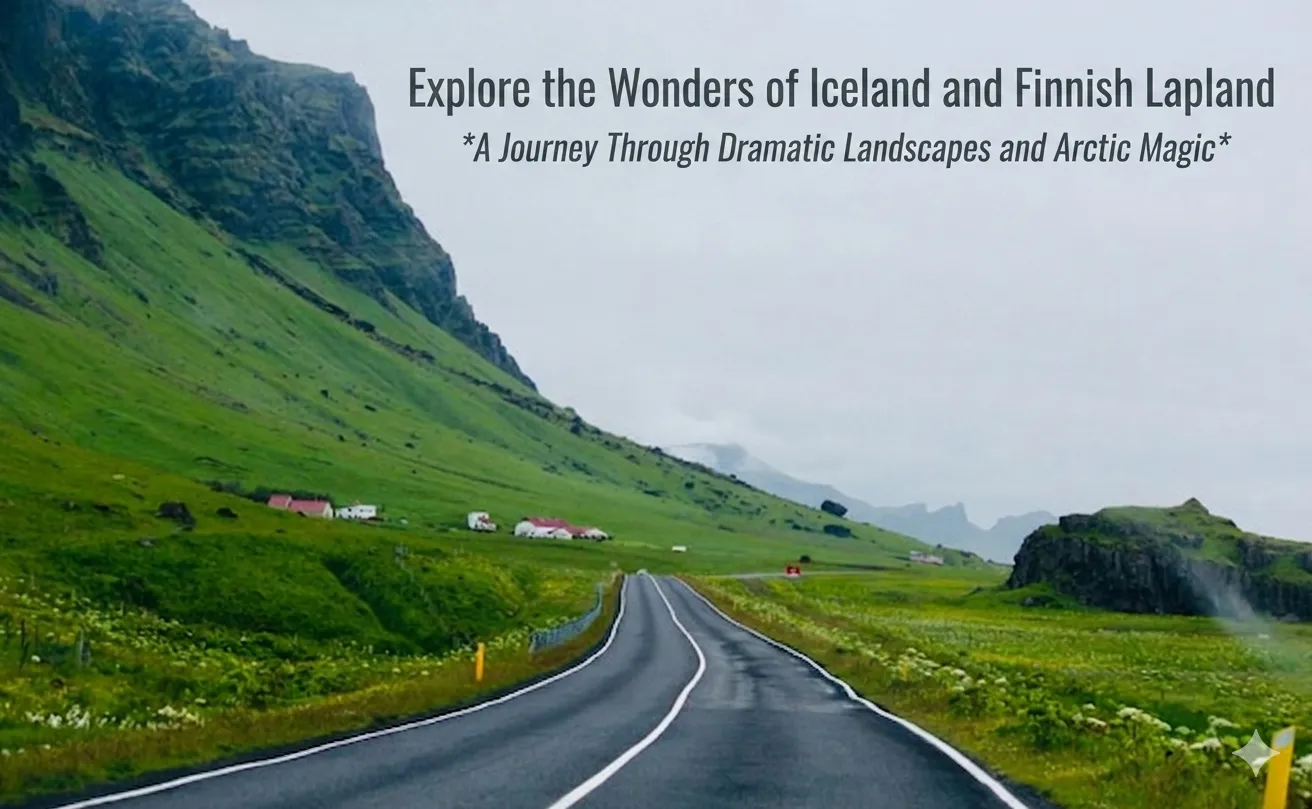
Some destinations make you feel like a competent, well-travelled adult who has their life together. Iceland and Finnish Lapland are not those destinations. Wonders of Iceland and Finnish Lapland places that will have you standing in a field at 2 am in a borrowed snowsuit, pointing at the sky and making sounds that no language has words for, wondering how you ever thought a beach holiday was sufficient. This article covers Wonders of Iceland and Finnish Lapland and what they offer, how to survive, and why you will start planning a return trip on the flight home.
Table of Contents
Wonders of Iceland – The Island That Skipped the Instruction Manual
Iceland was formed by volcanoes and has been causing problems ever since. The island sits on the Mid-Atlantic Ridge, where the North American and Eurasian tectonic plates are slowly pulling apart, which means the ground is actively moving beneath your feet at all times – not in a reassuring way, but in the way that reminds you the planet has its own agenda and humans are merely guests. The result is a landscape that looks like it was designed by someone who had seen Earth from space but never actually visited – black lava fields.
electric blue glacial rivers, geysers erupting on a schedule that puts most public transport to shame, and waterfalls that drop off cliff edges with the casual confidence of something that has been doing this for ten thousand years.
Reykjavik, the capital, is home to about 130,000 people, which means it is smaller than many suburbs of cities that would never dream of calling themselves a capital. It has the energy of a university town that somehow ended up running a country – independent coffee shops, bookshops selling more books per capita than anywhere else in the world, hot dog stands that locals will tell you are genuinely worth visiting.
and a music scene that has produced an implausible number of internationally known artists for a city of its size. The Hallgrímskirkja church dominates the skyline with a concrete facade that either looks like a rocket or an organ pipe, depending on your mood, and the view from its tower on a clear day stretches over the city to the mountains and the sea in a way that earns the climb.
The food in Iceland is built around what the island actually produces rather than what it wishes it produced. A lamb that has spent the summer wandering across lava fields, eating wild herbs. Arctic char from glacial rivers. Skyr, the thick dairy product that Icelanders have been eating for a thousand years, and that the rest of the world has only recently discovered. And hákarl – fermented Greenlandic shark aged underground for months, which smells strongly of ammonia and is served in small cubes on a toothpick,
presumably so you can drop it quickly if required. Eating hákarl is a rite of passage in Iceland, and the correct response upon tasting it is to look thoughtful rather than horrified, which requires practice.
Getting There – How to Organise the Chaos
Iceland is one of those destinations where the gap between a well-organised trip and a chaotic one is significant, because the country is large, the weather changes fast, and the best experiences tend to require being in the right place at the right time. Booking through specialists who know the island takes a substantial amount of guesswork out of the equation – tours to Iceland that are properly structured will sequence the Ring Road correctly.
Book accommodation in the parts of the country where accommodation books out months in advance, and have contingency plans for the not-uncommon situation where the road you planned to drive is temporarily closed because a volcano has inconveniently decided to do something. Independent travel is entirely possible and has its own rewards, but Iceland is the kind of place where the difference between a specialist’s local knowledge and a guidebook’s general advice becomes apparent within the first forty-eight hours.
The Golden Circle – the route that takes in Thingvellir National Park, the Geysir geothermal area, and Gullfoss waterfall – is the standard day trip from Reykjavik and is popular for the entirely sensible reason that it is very good. Thingvellir is where the Icelandic parliament, the Althing, was established in 930 AD, making it one of the oldest parliamentary sites in the world.
It also sits directly on the rift between the North American and Eurasian plates, so you can stand with one foot on each continent, which is either deeply meaningful or the best party trick in geopolitics, depending on your perspective. Geysir, the original geyser after which all others are named, no longer erupts reliably, but its neighbour Strokkur does so every five to ten minutes with a column of boiling water that reaches fifteen metres and never stops being dramatic regardless of how many times you watch it.
Also read: Best Guide to Explore Iceland by Bus
Best Places to See Northern Lights in Iceland
The aurora borealis is the reason many people come to see the Wonders of Iceland between September and April, and it is one of those natural phenomena that photographs cannot prepare you for in either direction – sometimes the display is modest and the photographs people have been sharing on social media look nothing like what you are seeing, and sometimes the sky turns green and purple and moves like something alive and you run out of words entirely.
The northern lights are caused by charged particles from the sun colliding with atmospheric gases, which is the scientific explanation that nobody is thinking about when they are standing in a field in minus fifteen degrees watching the sky do something that the human brain has no established category for.
Seeing the northern lights requires darkness, clear skies, and solar activity – three variables that Iceland controls none of. This is the part where patience and appropriate clothing become as important as any itinerary. The best strategy is to base yourself somewhere with low light pollution, check the aurora forecast provided by the Icelandic Met Office obsessively.
Be prepared to get up at three in the morning when conditions improve, and dress in several layers that would have seemed excessive before you understood what Icelandic winter actually means. The Snæfellsnes peninsula in the west, the Westfjords in the northwest, and the area around Lake Mývatn in the north all offer darker skies than the Reykjavik area and are worth the extra distance if seeing the lights is the primary goal.

Finnish Lapland – Snowmobiles, Huskies and the Art of Dressing
Finnish Lapland is not a destination that rewards underprepared visitors, and the most practical way to experience it properly is through operators who provide both the equipment and the knowledge to use it safely. Finnish Lapland tours that include snowmobile safaris, ice fishing, reindeer farm visits, and guided wilderness hikes sequence the activities in a way that makes logistical sense and ensures that the thermal suits, boots, and gloves provided are appropriate for the temperatures involved rather than the temperatures you expected.
Rovaniemi and the fell towns of Saariselkä, Levi, and Ylläs each have established operators offering day and multi-day programmes, and the infrastructure around aurora watching – purpose-built glass-roofed cabins, guided night safaris, meteorological monitoring – is more developed in Lapland than almost anywhere else in the world.
Snowmobile driving requires a driving licence and approximately thirty seconds of instruction before the first solo kilometre, which is either reassuring or alarming depending on your confidence with motorised vehicles. The machines are powerful enough to cover a significant distance and go fast enough in open terrain to make the wind chill a genuine factor on top of the ambient temperature.
Ice fishing, by contrast, involves drilling a hole in a frozen lake, lowering a line, and waiting in conditions of extreme quiet for something to happen – the meditative quality of this activity is either its greatest virtue or its principal drawback, and opinions divide sharply between people who find the silence transformative and people who last twelve minutes before checking their phone.
Rovaniemi – The Gateway That Takes Itself Seriously
Rovaniemi sits precisely on the Arctic Circle and functions as the main entry point for Finnish Lapland, with an airport, a train station, and enough tourist infrastructure to support the volume of visitors that has grown steadily since the city rebuilt itself after being burned to the ground by retreating German forces in 1944.
The rebuilding was designed by Alvar Aalto, which means Rovaniemi has one of the most architecturally considered city centres of any small northern city – the layout was planned in the shape of a reindeer’s head and antlers when seen from above, which is either visionary urban planning or a very good story depending on how much you trust aerial photography.
Santa Claus Village on the Arctic Circle just outside the city is either delightful or baffling, depending on your relationship with organised festive experience. Children find it entirely convincing, which is the point – Santa’s workshop, reindeer rides, husky safaris, and an address that allows letters sent from anywhere in the world to be replied to with a Finnish postmark from the Arctic Circle. Adults accompanying children find it effective.
Adults travelling without children find the surrounding wilderness considerably more interesting, though the husky sledding is worth doing regardless of age because being pulled across a frozen lake by twelve enthusiastic dogs produces a particular kind of joy that is difficult to access through other means.
Getting Around Lapland – Where Winter is Not a Season But a Lifestyle
Finnish Lapland begins roughly at the Arctic Circle. It extends north from there for another 300 kilometres, covering an area of boreal forest, frozen lakes, fell country, and tundra that together constitute Europe’s last genuine wilderness. It is cold in a way that is qualitatively different from the cold of cities further south – not just lower temperatures but a stillness, a dryness, and a completeness to the cold that changes how sound travels and how the air feels in your lungs.
In January, the temperature in northern Lapland regularly drops to minus thirty or below, at which point several things happen simultaneously – your eyelashes frost over, your camera battery dies in minutes. Your face produces an expression that suggests you are reconsidering every decision that led to this moment.
The reindeer situation in Lapland deserves early mention because it is not incidental. There are more reindeer in Finnish Lapland than people, and they have the road sense of someone who has never seen a car. They appear on roads at night, in blizzards, and in conditions where stopping requires the kind of winter driving technique that most visitors have not needed to develop.
Reindeer herding is an active industry in Lapland managed by the indigenous Sámi people and by Finnish herding families, and the animals’ grazing rights across the region are legally established – they have, in practical terms, priority over most other forms of land use, which is an interesting legal concept to discover when one is standing in the road ahead of one’s rental car.
Also Read: Solo Travel Tips in Iceland and cost
The Sámi Culture and Why It Matters
The indigenous Sámi people have lived in Lapland for thousands of years. And their culture – language, reindeer herding traditions, handicrafts, and relationship to the land – is not a museum exhibit but a living reality that contemporary tourism in the region is still working out how to engage with respectfully – one of the Wonders of Iceland. The Sámi Parliament of Finland in Inari represents. The Sámi people’s cultural autonomy, and the SIIDA museum in the same town, is the most comprehensive introduction to Sámi history and culture.
Available in Finnish Lapland – the permanent exhibition covers the relationship between the Sámi and the Arctic environment across centuries with a depth and a perspective that the reindeer-sleigh-and-photo-opportunity version of Lapland tourism rarely provides. Choosing operators who work in genuine partnership with Sámi communities, pay fair rates for knowledge and participation, and represent Sámi culture accurately rather than as a prop for the Arctic experience makes a material difference to where the money goes and what the visit actually means.
Best Places to See Northern Lights in Iceland
Northern lights are one of the most Wonders of Iceland. Finnish Lapland sits within the auroral oval – the band around the magnetic pole where aurora activity is most consistent. It gives it a statistical advantage over many other northern lights destinations. On a clear night between August and April, the probability of seeing aurora activity in northern Lapland is higher than in Iceland or Norway’s mainland.
Though weather and solar conditions remain the variables that no amount of good positioning can entirely overcome. The fell tops above the tree line in Saariselkä and Kilpisjärvi give unobstructed views of the northern horizon where the lights most commonly appear, and the combination of a snow-covered wilderness below and aurora above produces a visual experience that the glass-roofed cabin industry has built an entire business model around – with good reason.
Conclusion – The Wonders of Iceland and Finnish Lapland
Iceland and Finnish Lapland are the kind of destinations that recalibrate what you expect from travel. Both are cold, both are expensive, both require more preparation than a week in the Mediterranean, and both deliver experiences that people describe for years afterward to anyone who shows the slightest interest. Go to Iceland for the geological drama, the waterfalls, and the aurora over a landscape that looks like another planet.
Go to Lapland for the silence, the darkness, the northern lights over snow-covered forest, and the particular satisfaction of having been genuinely cold and genuinely far north. Go to both if you can, because the two together cover a range of what the Arctic and sub-Arctic world offers that neither manages alone. Pack more layers than you think you need. Then pack more.