Imagine a place so remote it was not accurately mapped until 1969. A place where every single resident shares the same last name. Where the main street is a sandy path lined with mahogany trees. Welcome to Palmerston Island. This tiny coral atoll in the Cook Islands sits at the very edge of the known world.
Only 25 to 35 people live here. Every one of them is a direct descendant of one man. His name was William Marsters, an English carpenter who arrived on the island in 1863. He settled here with three Polynesian wives. Today, the island is divided into three family branches. Each one traces its roots back to one of those original women.
There are no shops here. No airports. No cars. Life moves to the rhythm of the tides and the sound of daily church bells. A supply ship comes just a few times a year.
When you visit Palmerston Island, a local family adopts you. You step into a warm communal world where British customs blend with Polynesian island life.
For bold travelers, Palmerston is more than a destination. It is a journey back in time to the most isolated family reunion on Earth.
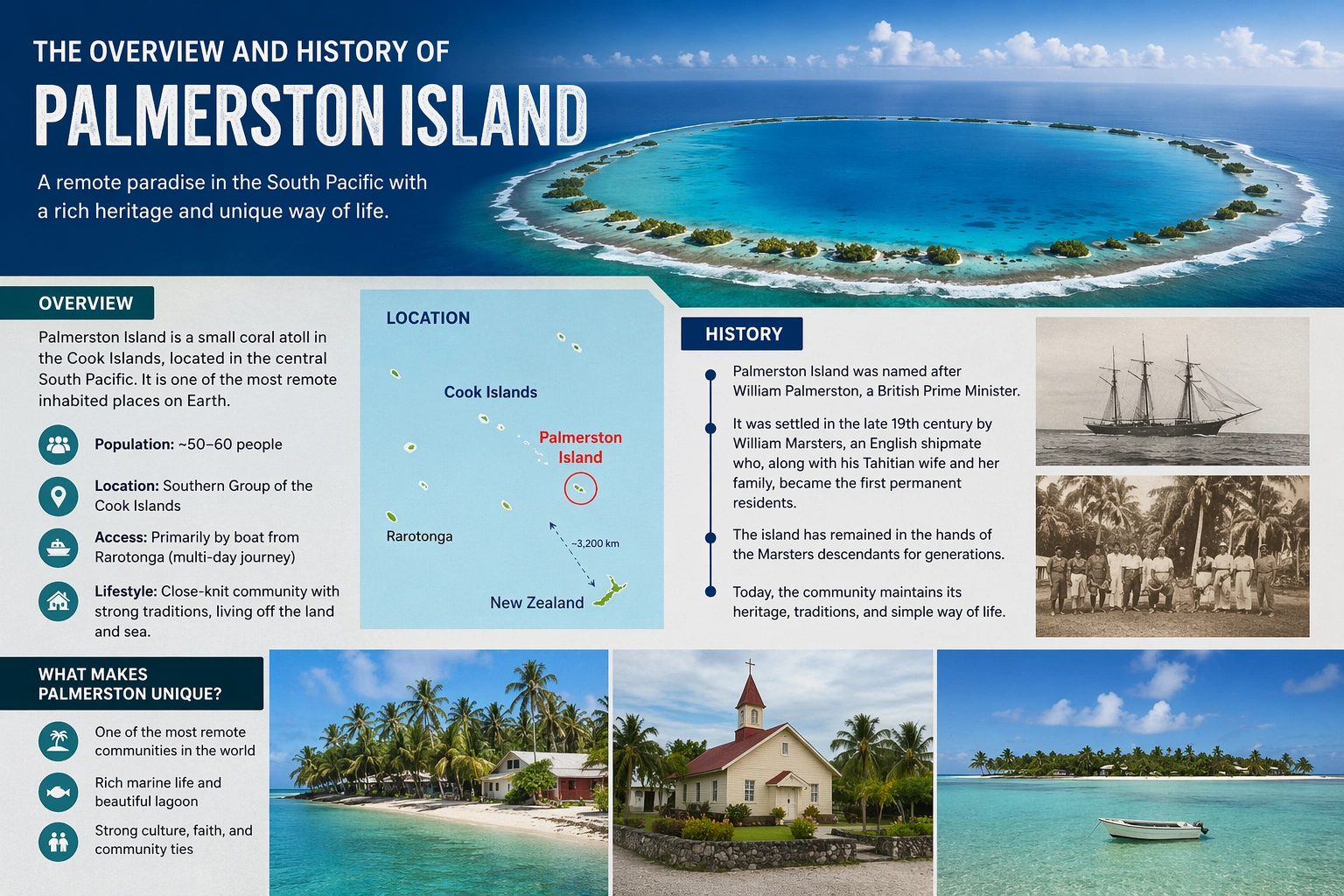
Table of Contents
The Overview and History of Palmerston Island
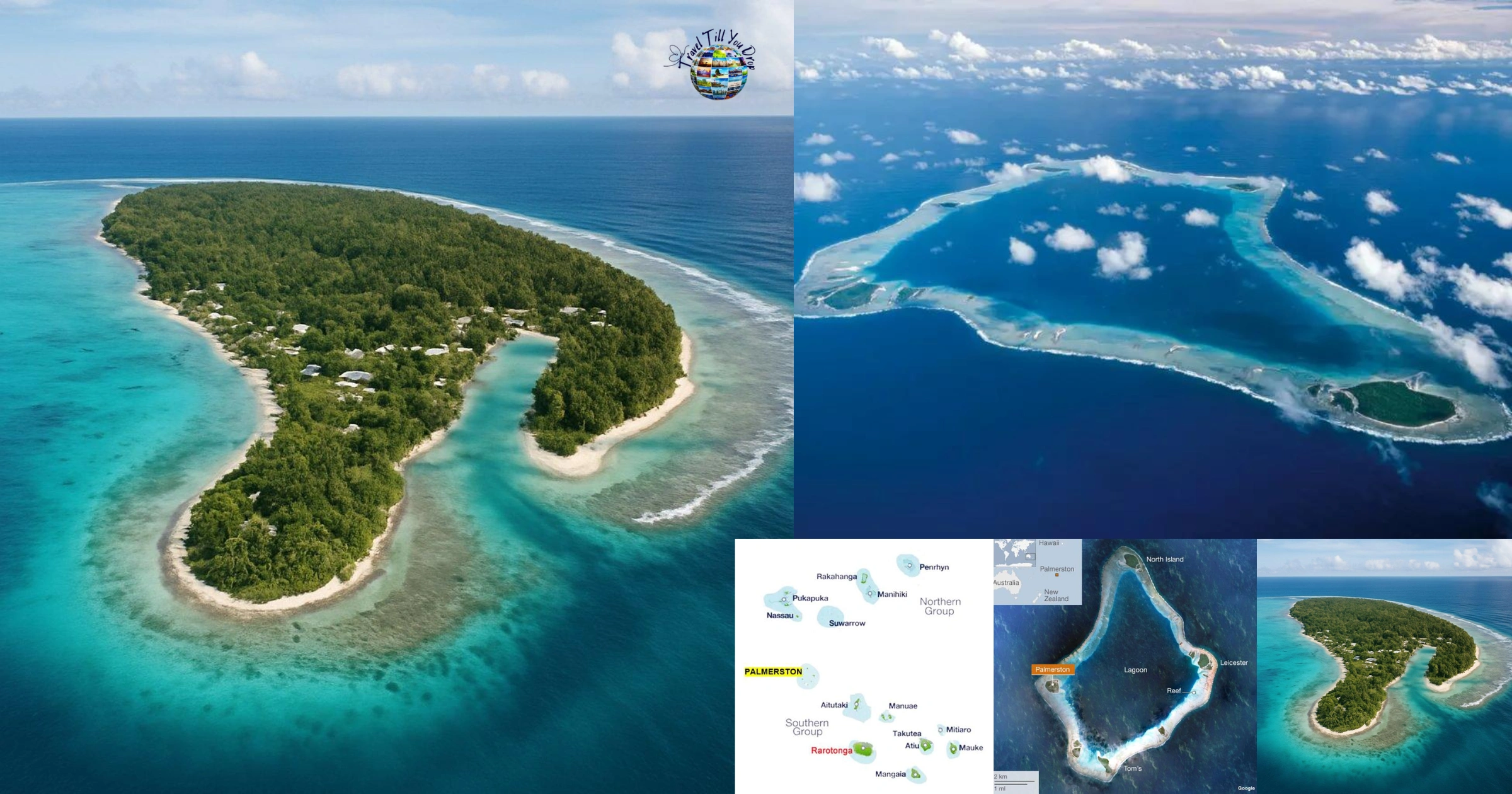
Palmerston Island is a true coral atoll. It looks like a shimmering necklace of six sandy islets wrapped around a turquoise lagoon that stretches 7 miles wide. It sits 310 miles from Rarotonga, making it one of the most isolated spots in the Cook Islands.
There is no airport here. The only way to reach it is by private yacht or supply ship. Ships brave the reef passages just a few times a year.
The total land area is just 1 square mile. The community lives on Home Island. Life here is built on self-sufficiency. Islanders use solar power and collect rainwater to survive. They rely on the sea for food. Parrotfish is a daily staple and the island’s main export.
The History of Palmerston Island
The modern story of Palmerston Island begins with one man. His name was William Marsters. He was an English carpenter from Leicestershire.
Captain James Cook discovered and named the island in 1774. It was empty at the time. Nearly a century later, in 1863, William Marsters arrived to run a copra plantation for a British trader. Copra is dried coconut used to make coconut oil.
The trader never came back. Marsters claimed the island as his own. He settled there with three Polynesian wives, all cousins from the island of Penrhyn. He went on to father 23 children.
To keep order on the island, Marsters created a social structure that still exists today.
- The Three Families. He divided the island into three sections, one for each wife and her descendants. The three family branches are known as Matavia, Akakaingaro, and Te Pou.
- The Marsters Name. Almost every permanent resident carries the Marsters surname. Marriage within your own family branch is strictly forbidden to prevent inbreeding.
- Island Ownership In 1954, the New Zealand government gave the Marsters family full legal ownership of the atoll. This is a rare status. It means the island belongs to them forever, and no one else can claim it.
What makes Palmerston Island unique
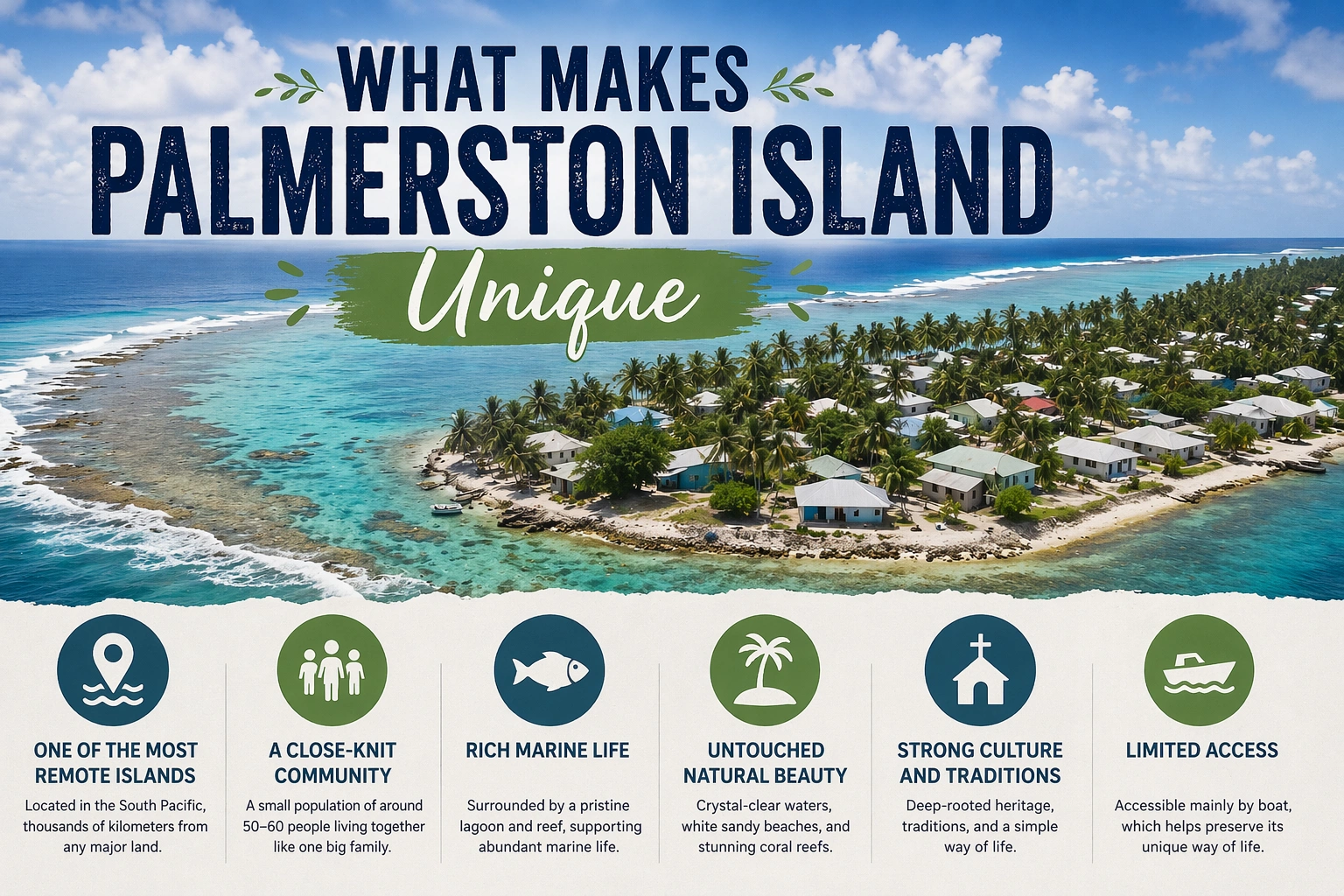
Palmerston Island is not just a remote island. It works more like one giant extended family. The social structure here is found nowhere else on Earth. That is what makes it truly one of a kind.
Here is what sets it apart:
1. A Single Ancestor Society
Almost every one of the 30 to 35 residents shares the same last name: Marsters. They are all direct descendants of William Marsters, an English carpenter who arrived in 1863 with three wives.
The island is divided into three zones. Each zone belongs to the descendants of one of those three wives. This three-family system controls everything from land rights to daily social life.
2. A Living Time Capsule Accent
The community stayed isolated for over a century. Because of this, the islanders speak English with a very unique accent. Visitors often notice a West Country or Gloucestershire lilt in their speech. It is a living echo of William Marsters’ original British dialect, blended with Polynesian tones.
You will not hear this accent anywhere else in the world.
3. The Adoption Custom
There are no hotels, or restaurants on Palmerston Island. When a boat arrives, the first family to reach it adopts the visitors. Those visitors then live with that family, eat at their table, and become part of the household for the whole stay.
There is no fixed fee. It is a true cultural exchange. Visitors usually bring supplies or gifts in return for the hospitality.
4. Extreme Isolation
You cannot simply book a trip to Palmerston Island. There is no airport. The reef is too dangerous for large ships to dock.
A supply ship visits only about twice a year. If it is delayed, islanders fall back on rainwater, solar power, and fish to survive.
The island’s main link to the outside world is parrotfish. Families catch and freeze the fish, then send them to Rarotonga on the rare supply ships.
5. Unique Legal Status
In 1954, the New Zealand government gave the Marsters family the right to live on and manage the island forever. The atoll is essentially private family land.
The Island Council is made up of the heads of the three family branches. This means 19th-century family law still shapes modern life on the island today.
Where is Palmerston Island Located?
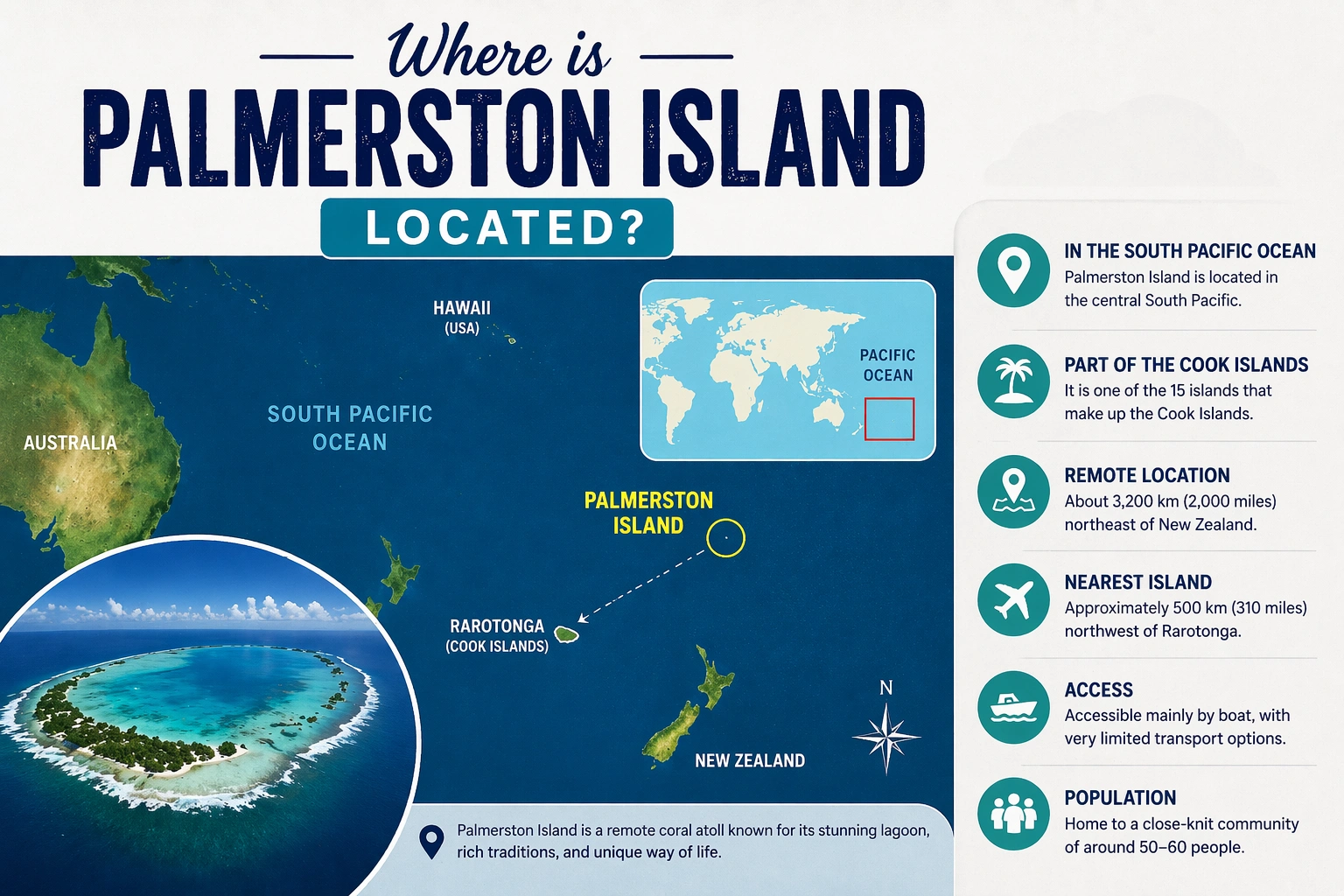
Palmerston Island is a remote coral atoll in the central Pacific Ocean. It is part of the Cook Islands, an island nation linked to New Zealand.
The island sits about 310 miles (500 km) northwest of Rarotonga, the capital of the Cook Islands. It is one of the most isolated inhabited places on Earth.
The atoll is made up of several small sandy islets. They all surround a calm central lagoon. The community lives on Home Island, the main islet of the group.
Life on Palmerston Island Today
Life on Palmerston Island in 2026 is a fascinating mix of old traditions and new technology. The island is still one of the most remote places on Earth. But life here is more connected than you might think.
1. No Longer Digitally Isolated
For many years, a single radiotelephone was the only link to the outside world. That has changed.
The island now has Starlink internet. Students at the Palmerston Lucky School can access global resources online. Residents stay in touch with thousands of fellow Marsters family members living in New Zealand and Australia.
The island has also switched from noisy diesel generators to a solar energy grid. Every home now gets 24-hour electricity from clean solar power.
2. The Three Family Work Ethic
The population is small, somewhere between 25 and 62 people. So everyone does a bit of everything.
A typical day might look like this. In the morning, residents help at the school or the administration center. In the afternoon, they fish for parrotfish or work on a community project. In the evening, they sweep their section of the sandy main street. Every family is responsible for keeping their part of the island’s paths clean and free of fallen leaves. It is a community rule.
3. Sustainability and Survival
The supply ship arrives only 3 to 4 times a year. This means careful planning is a way of life.
Most food is grown or caught fresh. Freezers store parrotfish for export. Bosun birds, also known as red-tailed tropicbirds, are also hunted. This happens on the 28th of every month under a strict rule set by William Marsters himself. The rule keeps the bird population sustainable.
Every home collects and stores its own rainwater. There is no running water system on the island.
4. Sunday is Sacred
Sunday is the most important day of the week. No work is allowed. No fishing. No gardening.
The whole community dresses in their best clothes, often wearing traditional hand-woven hats. Everyone attends the local church together. The sound of the Marsters family singing hymns in harmony is one of the most memorable experiences for the few travelers who ever make it here.
5. Modern Challenges
The internet has connected the island to the world. But it has also brought new problems.
Many young people are leaving. They go to Rarotonga or New Zealand for education or to find partners outside their small genetic pool. This brain drain is a growing concern.
Rising sea levels are also a threat. The highest point on the island is only about 20 feet above sea level. Protecting the atoll from the ocean is the community’s biggest long-term challenge.
Why Palmerston Island is So Isolated?
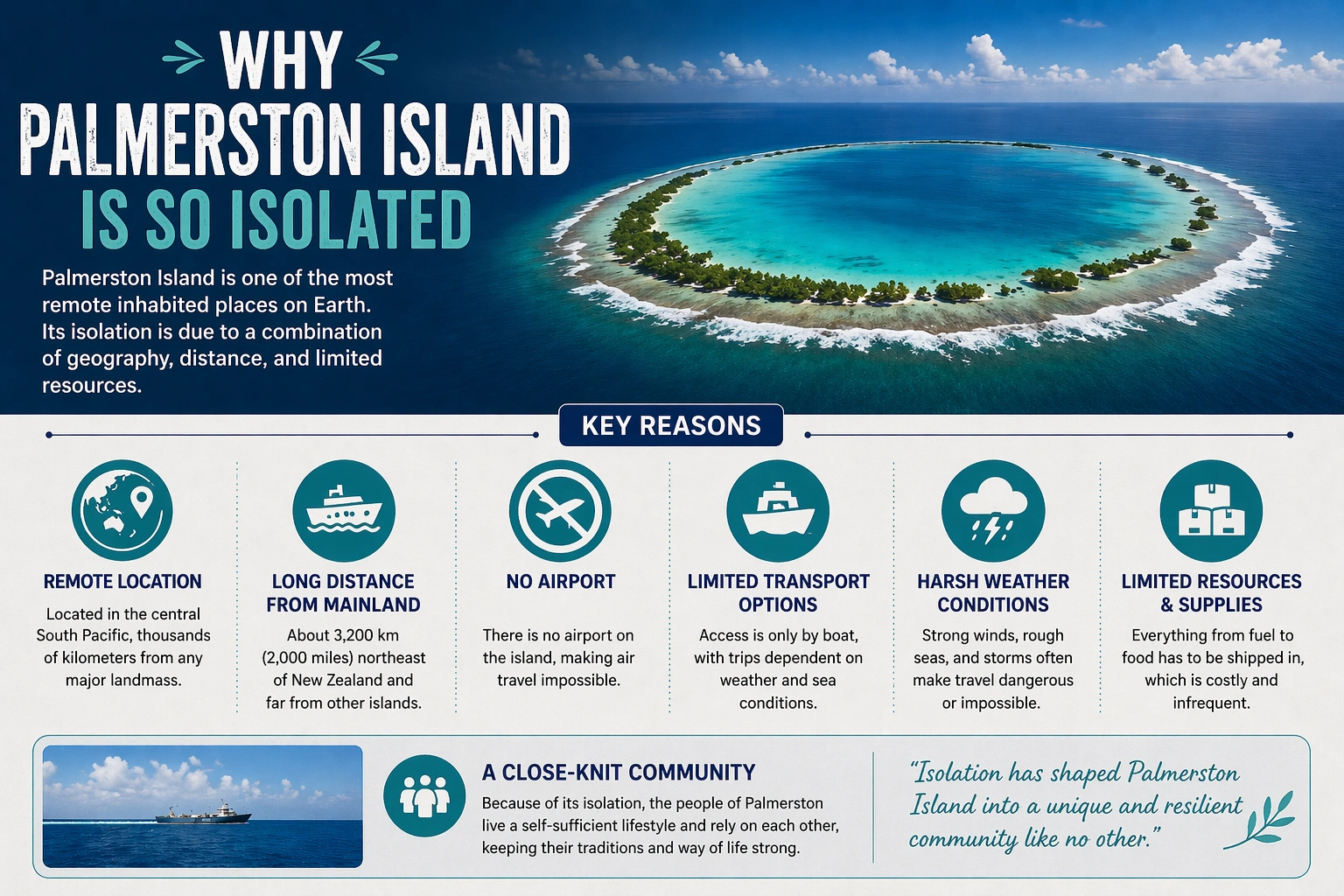
Palmerston Island is not just remote. It is one of the hardest places on Earth to reach. Its isolation comes from its location in the middle of the ocean, its dangerous reef, and a complete lack of modern transport.
Here is why getting there is such a challenge:
1. No Airport, No Airstrip
Unlike Easter Island or St. Helena, Palmerston has no airport and no airstrip at all. The atoll is too small. The coral sand is too soft and unstable to support a runway. Even seaplanes cannot land safely unless the weather is perfect.
This means flying is not an option. Your only way in is by sea.
2. A Natural Wall of Coral
A sharp coral reef surrounds the atoll. It forms a natural barrier all the way around the island.
Large ships cannot enter the lagoon. They must stay out in the open ocean. To reach Home Island, visitors must climb into a small local boat and transfer from the ship. The islanders then navigate through narrow gaps in the reef that are barely wide enough for a small boat.
If the swells are too high, nobody gets on or off the island. Full stop.
3. A 500 km Ocean Gap
Palmerston sits alone in a vast, empty stretch of the South Pacific. The nearest island is Rarotonga, about 500 km (310 miles) away.
A modern yacht takes two to three days of non-stop sailing to cover that distance. Supply ships only make the trip every 3 to 6 months. If you miss one, you wait for the next. There is no other option.
4. Zero Commercial Tourism
There are no cruise ship docks. No regular ferry services. No travel companies run scheduled trips to Palmerston. The population is too small for any business to make a profit from it.
Your only real options are to own a blue water sailing yacht or hitch a ride on a government supply ship. And that ship puts bags of cement and frozen goods ahead of passengers every single time.
How to Reach Palmerston Island?
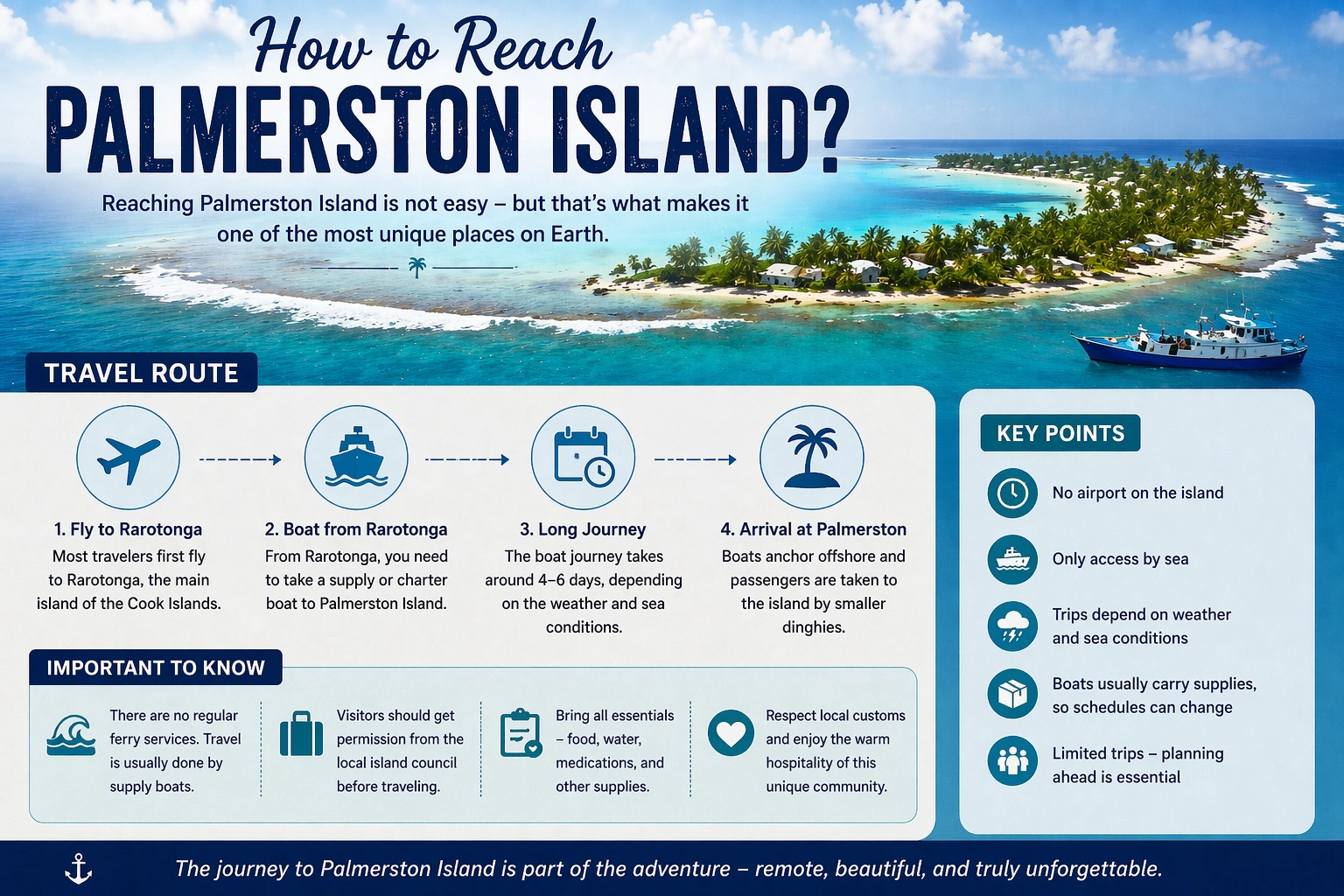
Getting to Palmerston Island is an adventure on its own. There is no airport and no regular ferry service. It is one of the most logistically challenging places on Earth to visit.
As of March 2026, there are only three ways to reach the atoll.
1. The Cargo Ship: The Local Way
This is the only semi-regular transport option for those who do not own a yacht.
Taio Shipping, based in Rarotonga, operates cargo vessels like the MV Lady Moana and MV Maungaroa III. Ships head out to the Northern Group islands roughly every 2 to 3 months. The schedule is irregular, so you need to plan well ahead.
The journey from Rarotonga takes 2 to 4 days, depending on the weather and ship speed. You are hitching a ride on a working freighter.
One important warning: if the return ship is delayed, you could be stuck on the island for months. Be prepared for that possibility before you go.
2. Expedition Cruise: The Luxury Way
High-end expedition cruise lines have started adding Palmerston as a rare stop. This is the only way to visit with a guaranteed departure date.
Lines such as SilverSea, Ponant, and Seabourn occasionally include Palmerston on their South Pacific itineraries. The Scenic Eclipse had a scheduled stop in March 2026.
These ships stay for just one day. Local islanders ferry you across the reef in small boats for a few hours of cultural experience. Then the ship moves on.
3. Private Yacht: The Intrepid Way
Most non-resident visitors arrive by private sailing yacht. The best time to sail is between May and September, outside of cyclone season.
As you approach, you must call the Palmerston Island Administration on VHF Channel 16. You cannot anchor near the island. Instead, you must use one of the designated mooring buoys outside the reef. An islander will then come out to meet you and bring you to shore.
Essential Planning Tips
- Landing fee: There are no hotels on the island. You are expected to pay a small landing fee of around $5 to $10 NZD. A gift or contribution to the host family is also welcome and appreciated.
- Permission is required: You must contact the Palmerston Island Administration by email or radio before your trip. They have the right to refuse visitors if the island is low on supplies or during community events.
- Bring your own supplies: If you are traveling by cargo ship, pack all your own medical supplies and any specific food you need. The island store, when stocked, carries only basics like flour, sugar, and rice.
Staying on Palmerston Island
Staying on Palmerston Island is unlike any other experience in the world. There are no hotels, no resorts, and no rentals of any kind. Instead, everything is governed by one beautiful tradition called the Adoption Custom. It has stayed the same for over 150 years.
1. The Adoption Custom
When you arrive at Palmerston, you do not choose where to stay. The first family to reach your vessel at the reef adopts you. That is the rule.
You become an honorary member of one of the three Marsters family branches. You stay in their home, eat their food, and take part in their daily life. This is not a hotel service. It is a deep and real cultural experience.
2. Costs and Fees
The hospitality is communal, but some fees help keep the island running. As of 2026, here is what to expect.
The entry and landing fee is around $50 NZD per person. Cruise ship visitors may pay a higher rate. There is also a small New Zealand head tax of about $5 NZD.
If you arrive by yacht, mooring fees apply. Expect to pay around $10 NZD per night. Anchoring directly is not allowed as it damages the coral reef.
3. Etiquette and Rules
Life on a small island runs on mutual respect. Visitors are expected to follow local customs at all times.
- Sunday observance is taken very seriously. No work, fishing, or loud activities are allowed on Sundays. Visitors are welcome and encouraged to attend church. The family singing is truly something special.
- Dress modestly when walking through the village or attending church. Cover your shoulders and knees. Swimwear stays at the beach.
- Bring gifts. Your host family provides all your meals and housing. A thoughtful gift goes a long way. Good options include quality coffee, solar lights, school supplies, or practical tools that are hard to find on the island.
4. How to Arrange Your Stay
You cannot book a stay on any travel website. If you see online listings for Palmerston, they are likely for Palmerston in New Zealand or resorts on nearby Aitutaki. Do not confuse them.
To visit, contact the Palmerston Island Administration directly. You can reach them by email at palmerstonoffice@gmail.com or by VHF radio as you approach the island.
Give as much notice as possible, especially if you are traveling by supply ship. This gives the families time to prepare for your arrival.
Things to Do on Palmerston Island?
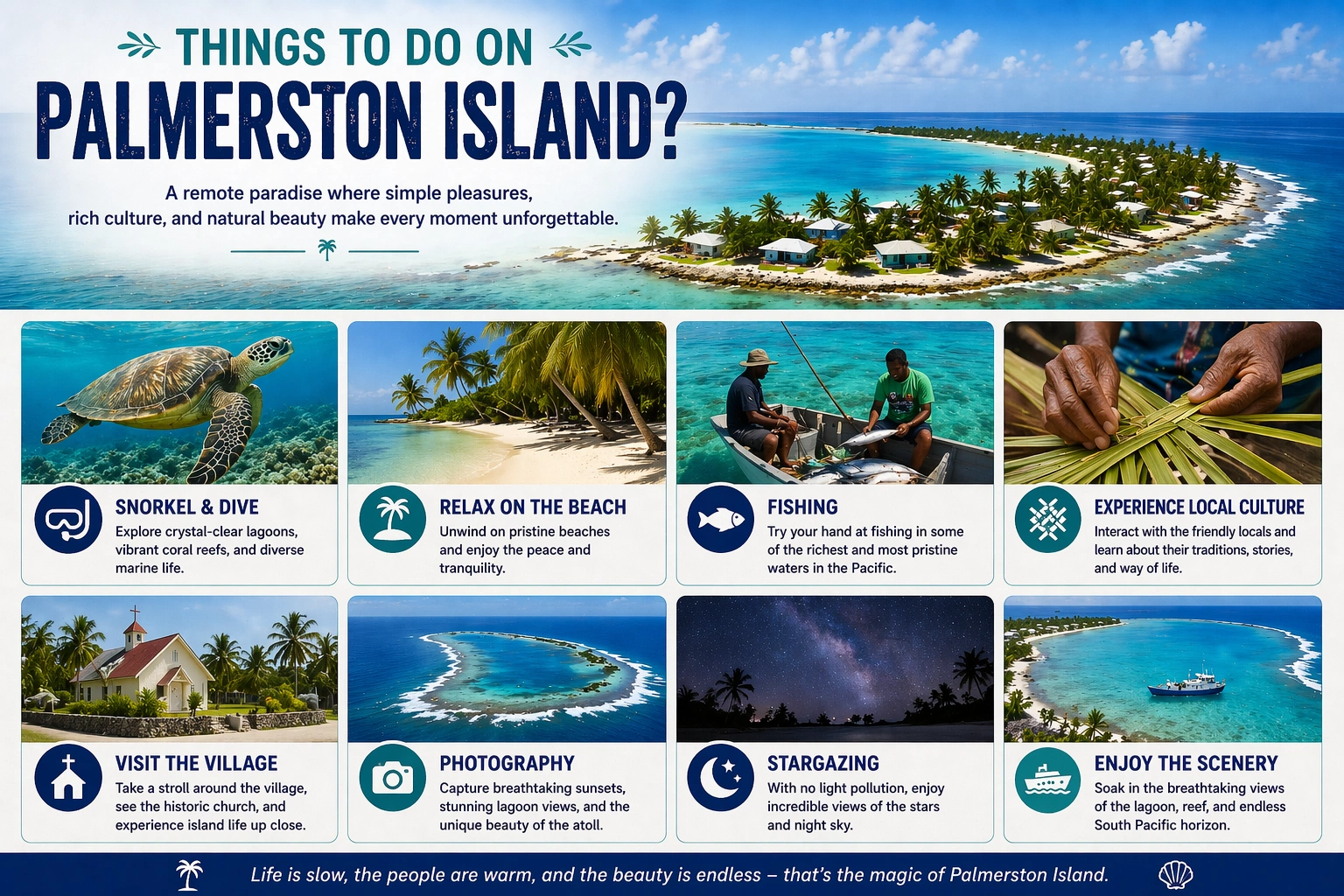
Palmerston Island offers a rare glimpse into a way of life that has stayed the same for over 150 years. There is no commercial tourism here. So the things you do revolve around joining the daily life of the Marsters family and exploring the natural beauty of the atoll.
- Cultural Immersion and Village Life
The most powerful experience on Palmerston Island is being adopted into a local home. The most memorable moments are not planned tours. They are simple acts of everyday communal living.
Church Services Attending a Sunday service is a highlight for many visitors. The community is known for its stunning a cappella hymn singing. The sound fills the whole small village and stays with you long after you leave.
The Lucky School Visitors are often invited to meet the children at the local school. You share stories about the outside world. The kids share their island life with you. It is a genuine cross-cultural exchange that money cannot buy.
Village Maintenance: Keeping the sandy main street clean is a local tradition. You may find yourself joining your host family in the daily ritual of sweeping the coral paths under the mahogany trees. It is simple, peaceful, and deeply connected to island life.
Marine and Outdoor Exploration
The island’s life centers on its large central lagoon and the surrounding reef. Because so few people ever visit, the water here is exceptionally clear, and the marine life is thriving.
Parrotfish Fishing Join local fishermen as they head out to the reef to catch parrotfish. This fish is the island’s main food source and its primary export. Learning their traditional fishing methods gives you a hands-on look at how the island survives.
Snorkeling the Canyons. The reef around the atoll has dramatic coral formations and deep underwater canyons. Reef sharks, turtles, and colorful coral colonies are common sights. Because almost no one swims here, the marine life shows little fear of humans.
Bird Watching on the Islets. The atoll has five uninhabited islets beyond Home Island. Take a small boat out to see nesting colonies of Frigatebirds and Red-tailed Tropicbirds, known locally as Bosun birds. It is a peaceful and rarely seen slice of Pacific wildlife.
Living History
The whole island is a living monument to William Marsters and his three families.
The Marsters Cemetery: Visit the graves of the original settlers. It gives you a quiet and powerful sense of the island’s unique lineage and how this community began.
Heritage Walks: Walk the boundaries of the three family sectors with your host as a guide. You will hear the oral histories, the land stories, and the family disputes that have shaped this community since 1863. There is no guidebook for this. It is all passed down by word of mouth.
Best Time to Visit Palmerston Island?
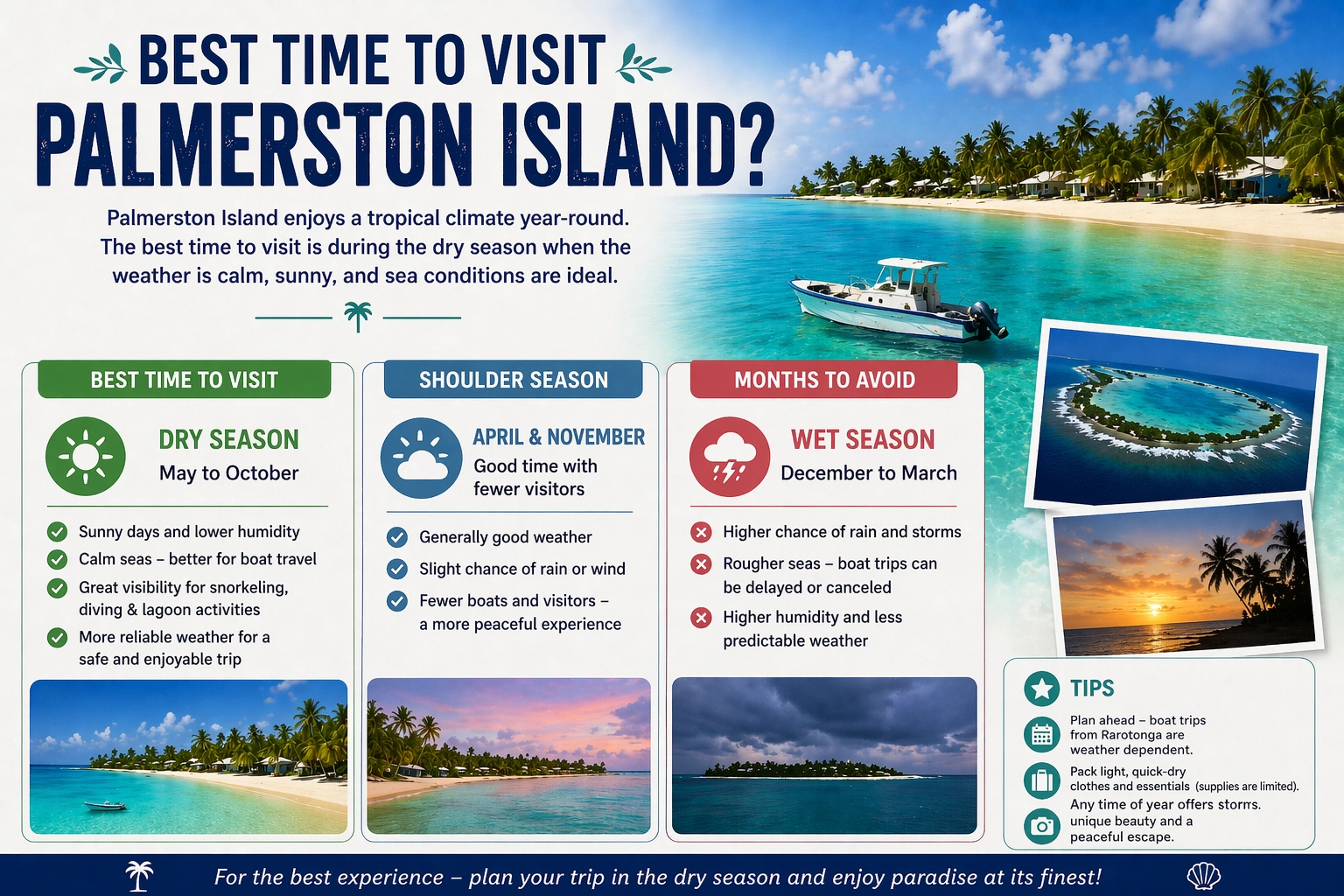
For a place as remote as Palmerston Island, timing your visit is just as important as planning how to get there. There are no runways. Your trip depends entirely on the mood of the Pacific Ocean and the rare arrival of ships.
The best time to visit is during the dry season, which runs from April to November.
The Sweet Spot: June to August
This is the best window for most travelers.
The weather is at its finest during these months. Humidity is low, and rainfall is minimal. Temperatures sit at a comfortable 25°C to 27°C.
The trade winds are steady, and ocean swells are calmer. This matters a lot because you must cross the dangerous reef in a small boat to reach the shore. Calm seas make this much safer.
Visit between July and October, and you have a strong chance of seeing Humpback whales breaching just off the reef.
Shoulder Season: April to May and September to October
These months offer good weather with even fewer visitors.
October brings a slight rise in humidity, but the island is at its quietest during this time. Late September is especially beautiful. The angle of the sun makes the lagoon water look an even deeper shade of turquoise.
Avoid: December to March
This is summer in the Southern Hemisphere and cyclone season in the South Pacific.
Palmerston Island is one of the most cyclone-prone islands in the Cook Islands. In February 2026, the region was hit by several tropical storms that made reef crossings impossible.
Expect heavy rain and high humidity during these months. Travel is not forbidden, but most private yachts and supply ships avoid the area for safety reasons.
2026 Travel Dates to Know
If you want a concrete way to get there this year, here are some options.
The Scenic Eclipse expedition cruise had a rare scheduled stop at Palmerston on March 20, 2026.
As of late February 2026, the MV Taunga Nui was scheduled to sail to Palmerston in May 2026. Passenger berths on supply ships fill up months in advance, so book as early as possible.